

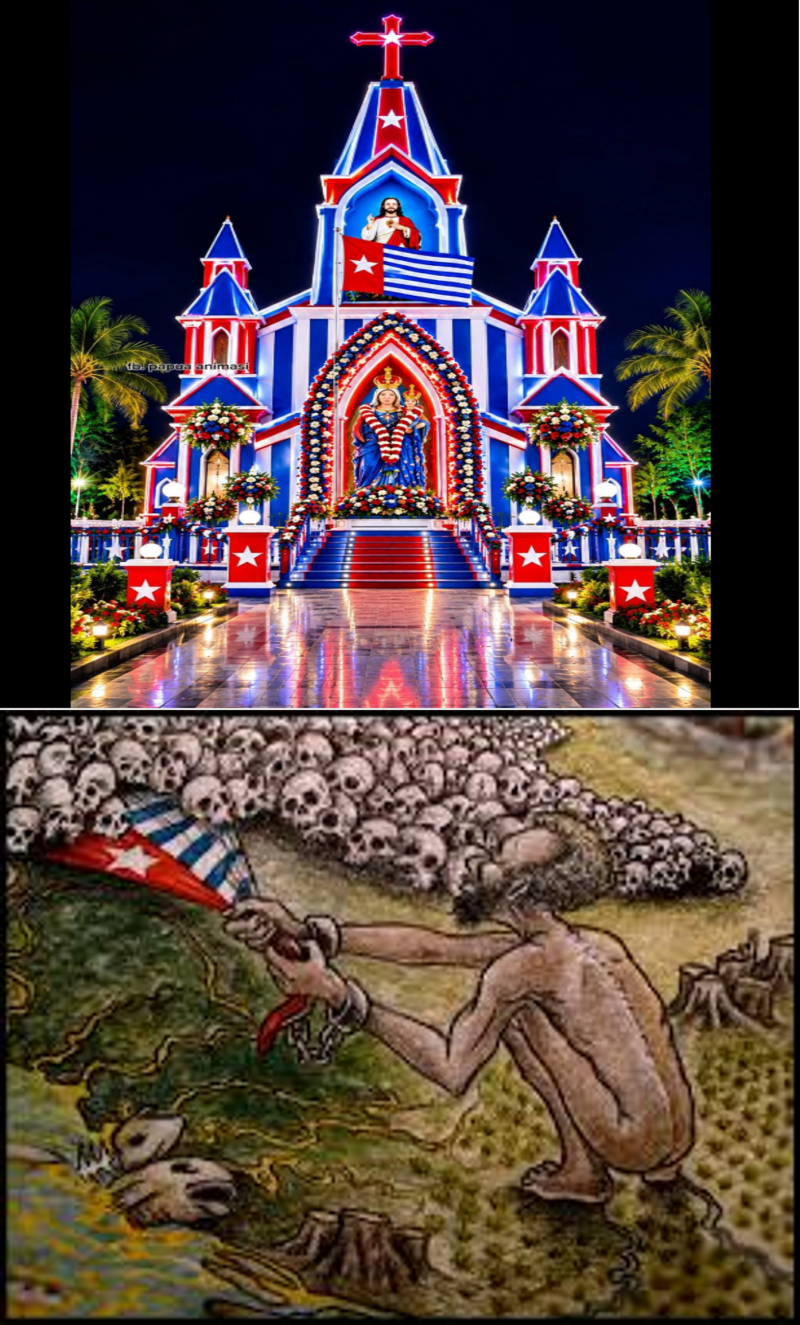
Cosmological Homelessness
How Papua's Sacred World Was Transferred to Another Place
From Jerusalem to the "end of the earth": how a people's devotion was redirected from their own land toward an unreachable horizon—and why this redirection, rather than the soldier standing at the checkpoint, may constitute the deeper wound.
Every Papuan Christian inherits a map before they ever have the opportunity to question it. It is a map that may never be drawn on paper, yet it is carried inside the mind with extraordinary precision. It begins in Jerusalem. From there it crosses the Mediterranean, moves through Europe, travels across the Atlantic, passes through Africa and Asia, and eventually arrives in West Papua. Missionary history has often understood this movement as the fulfilment of the Great Commission: the carrying of the Gospel "to the ends of the earth." Papuans were not merely told that the Gospel had arrived among them. They were often positioned within a larger sacred geography as one of the last peoples to receive it, as though their land represented the final geographical chamber into which an already completed sacred history had entered.
West Papua therefore became not the centre of its own sacred universe, but the distant terminus of someone else's.
This is not a footnote to the Papuan story. It is one of the load-bearing structures of the story itself. A sacred geography centred thousands of kilometres away has been installed inside a cosmobian world that already possessed its own centre, its own sacred ground, its own ancestral memory, its own ordering of time, its own relationship between the living, the dead, the land, and the unseen.
What happens when one cosmology is installed inside another is not simply that a new religion is adopted. Something much more profound occurs. The location from which reality itself is interpreted begins to move. The person remains on the land, but the centre of the universe has departed.
This is where the wound becomes difficult to see. The body has not necessarily moved. The village may still stand. The mountains remain visible. The rivers still descend from the highlands, and the ancestors remain buried in the earth—yet the sacred centre through which the world is interpreted, and through which all its meaning and purpose is drawn, has been relocated elsewhere. A colonised people can therefore remain geographically present while becoming cosmologically displaced, living upon their own land while being taught to understand ultimate reality through another land, another history, another ancestry, another sacred geography, and another promised destination.
The result is not merely religious conversion. It is cosmological homelessness.
The Two-Front War
Colonial domination in West Papua has always operated on more than one battlefield, and the cruelty of the arrangement lies precisely in the fact that the two battlefields conceal one another.
On the first battlefield, the Papuan body is seized: stopped at checkpoints, beaten in detention, displaced from villages, hunted through forests, imprisoned for raising a flag, watched by soldiers and informants, or transformed by colonial representations into an object of suspicion, curiosity, or threat rather than a human subject carrying memory, grief, ancestry, and claims to land. This violence is visible because the body registers it.
The second battlefield is quieter. Here the body is not seized; the mind is. The person is gradually moved from the house of their own cosmology into a house constructed by another civilisation. They are told that this new house is not simply another way of understanding existence, but the house of ultimate truth itself. Their ancestral world is reduced to the temporary, the earthly, the primitive, the superstitious, or demonic, while the imported world is elevated into eternity. The colonised person (Papuan) therefore does not experience the operation as expulsion. They experience it as salvation.
This is the deeper mechanism of what this paper calls transference. Physical conquest announces itself through force—the checkpoint, the gun, the bombing, the prison, the raid, and the displacement are immediately recognisable as violence. Cosmological transference does something much more sophisticated. It does not necessarily demand that the conquered person abandon their land physically; it persuades them to abandon the land as the ultimate location of meaning. The conquered body remains, tortured, but the centre of their own reality is surgically removed and transferred. And because the transfer is presented as salvation, the victim experiences the very mechanism of displacement as a gift, as good news, even as a gift from the gods—or, worse, from the only god. This inducement buries the person alive in a metaphysical coma, one in which a colonised elite can be sedated into this state and become a lethal instrument used to exterminate his own people and steal his own land.
This is why cosmological conquest becomes more enduring than physical conquest. A colonial soldier must continually stand at the checkpoint. A cosmology stands inside the mind long after the soldier has disappeared. The most frightening form of colonial power is therefore not the power that commands a person to kneel. It is the power that teaches the person to kneel willingly before the very architecture that displaced and ultimately replaced them.
The Gift That Is Not Good News
The second front arrives under the language of euangelion—good news. But follow the gift to the place where it lands, and the word "good" begins to fracture. It becomes psychosocially so twisted between the pain of colonisation and the counterfeit promise of salvation. The Papuan body receiving this message is simultaneously being described through another civilisational vocabulary as primitive, pagan, savage, backward, cannibal, uncivilised, or spiritually lost. Ancestral religion is branded as devil-worship, ritual transformed into superstition, indigenous nakedness turned into shame, and indigenous cosmology recoded as ignorance waiting to be corrected. The contradiction is almost unbearable in its simplicity. Your ancestors were darkness. Your world was darkness. Your rituals were darkness. Your body must be disciplined. Your history must be rewritten. But we have brought you the light.
The violence is therefore not confined to what is destroyed. It lies also in the replacement of the categories through which destruction can be recognised. The operation creates a metaphysical counterfeit—counterfeit not because every element of Christian faith is necessarily false, nor because every Christian believer is an instrument of colonialism, but counterfeit in the Psycho-Cosmocide sense because a structure of meaning presents itself as liberation while simultaneously participating in the displacement of the very world from which liberation would have to emerge.
The counterfeit is extraordinarily powerful because it does not simply steal hope. It steals the wound and returns a psalm. It takes grief and gives it patience. It takes dispossession and gives it heaven. It takes historical violence and gives it providence. It takes a demand for justice and moves it toward an unreachable horizon – heaven.
The most efficient anaesthetic is not the absence of pain. It is the transformation of pain into something the sufferer has been taught to regard as meaningful, necessary, temporary, or spiritually productive or even worse (God’s will).
That is why the mechanism can survive for generations. The victim does not necessarily stop suffering. The victim is taught what their suffering means.
The Metaphysical Weapon That Became a Theatre of Extinction
The deepest mistake in diagnosing the religion of the coloniser is to assume that everything it carries must therefore be rejected. That is too simplistic. There are metaphysical teachings within the religions carried by colonising civilisations that contain truths of profound existential value: love, forgiveness, and mercy can be real; sacrifice, covenant, and repentance can be real; the dignity of the suffering body can be real; the refusal to allow hatred to consume the human being can be real. These are not trivial inventions, and Psycho-Cosmocide does not require the colonised to become spiritually empty in order to become free. The question is not whether the teaching contains truth. The question is what the truth does when it enters a colonised world.
A metaphysical teaching can become existentially valuable when it becomes the glue of a broken people—when love becomes the force by which the wounded learn to trust one another again, when forgiveness becomes the mechanism through which generations of internalised suspicion, betrayal, humiliation, and division can be interrupted, when mercy becomes the refusal to reproduce upon one another the violence that has been inflicted upon them, when covenant becomes an obligation to remain with one another when remaining together becomes difficult, and when faith becomes the force that keeps the people from surrendering their humanity while their enemies are attempting to destroy it.
In that form, metaphysics becomes material. It enters the body, the broken family, the divided village, the relationship between traumatised generations. It repairs the torn social fabric. It takes people who have been taught to distrust one another and teaches them again how to stand together.
This is where religion can become an existential technology of survival. The colonised do not need a theology that teaches them merely how to die beautifully and receive rewards in heaven. They need a metaphysics capable of teaching them how to remain alive together and to reclaim every value and meaning of their being that has been stripped away by their enemies. The distinction is enormous.
A metaphysics of love that produces solidarity is a weapon against extinction. A metaphysics of forgiveness that restores trust is a weapon against fragmentation. A metaphysics of sacrifice that teaches responsibility toward future generations is a weapon against disappearance. A metaphysics of resurrection that insists death does not have the final word can become a refusal to surrender the living to despair. And a metaphysics of covenant can become the glue that prevents a people from dissolving into isolated individuals, competing elites, rival factions, traumatised families, and mutually suspicious communities.
This is the religious possibility that Psycho-Cosmocide must not destroy in the process of diagnosing colonial religion. The question is not whether the colonised should throw away every metaphysical instrument handed to them by the coloniser, but whether they can take the weapon away from the hand that delivered it.
A teaching can cross a colonial boundary and cease to belong exclusively to the civilisation that transported it. The colonised can embody it differently—turning love into solidarity, forgiveness into reconstruction, faith into endurance, covenant into collective responsibility, and resurrection into the refusal of extinction, until the sacred itself becomes a force that binds the living to the land, the dead to the living, and the living to the unborn. Then metaphysics ceases to be an escape from history. It becomes a force for entering history with greater strength.
But here lies the terrible threshold. The same metaphysics can be transformed into something else. When love is performed while the people are being destroyed, it becomes theatre. When forgiveness is demanded from the wounded while the machinery of injury remains intact, it becomes sedation. When prayer substitutes for organisation, it becomes paralysis. When heaven becomes more urgent than the survival of the people on earth, transcendence becomes displacement. And when resurrection is endlessly performed while language dies, land disappears, children become alienated from their ancestry, and communities fragment before the eyes of their own leaders, the sacred performance begins to resemble a ritual conducted inside an extinction chamber.
This is the point at which metaphysics becomes infected. The teaching itself may not have changed; its function has. It has ceased to be existential glue and become theatre in the dramatic spectacle of extinction. The colonised gather, sing, pray, and forgive; they perform Easter, proclaim love, speak of resurrection, and announce victory in heaven—and outside the walls of the performance, the actual conditions of existence continue to disappear.
The land is taken, language disappears, children forget, memory is erased, the people fragment, the dead accumulate, and the enemy advances. Yet the performance continues.
This is where the religious form becomes what the Psycho-Cosmocide corpus calls a virus—not because prayer itself is a virus, not because Christianity itself is a virus, and not because forgiveness is a virus. The virus lies in the transformation of a potentially life-giving metaphysics into a mechanism that allows extinction to continue without generating the existential response required to interrupt it.
The sacred becomes disconnected from survival, the performance becomes detached from the body: the body is dying while the theology is celebrating, and the contradiction becomes so normal that nobody asks why. This is the Theatre of Extinction. The people perform the symbols of salvation while the conditions of their earthly existence are being dismantled. They perform resurrection while memory is dying, reconciliation while the community is being fractured, forgiveness while dispossession continues, and eternal life while the living is losing the land necessary to raise the next generation. At this point religion has become a spectacle in which the audience is simultaneously the victim, the actor, and the disappearing subject. The most terrifying theatre is one in which the audience does not know that the play is about its own extinction.
When the Metaphysical Weapon Turns Inward
This is also why colonised elites can become capable of fighting one another with extraordinary ferocity while the coloniser stands at a comfortable distance, untouched by the violence their own architecture set in motion.
When the metaphysics of salvation is absorbed without the machinery of continuity, it does not simply produce passivity. It also produces fratricide. A people taught to interpret their suffering through frameworks of sin, purity, and divine favour begin to apply those same categories to one another rather than to the structure that produced their condition. One faction becomes the righteous remnant; another becomes the backslidden, the compromised, the cursed. Denominational rivalry, tribal suspicion, and competing claims to spiritual legitimacy are recruited into the same theological vocabulary that was meant to offer comfort, and turned instead into instruments of internal division.
This is the CPCV operating at its most efficient. It does not need the coloniser to manufacture the conflict directly. It only needs to have installed a framework capacious enough that the colonised generate the conflict themselves, using the coloniser's own categories of light and darkness, salvation and damnation, the saved and the lost. The enemy at the checkpoint recedes from view, while the neighbour, the rival pastor, the rival clan, or the rival faction becomes the visible target of a rage that was never actually about them.
The tragedy is doubled. Not only is the wound displaced onto the wrong perpetrator, as described above; it is displaced onto the wrong victim. Energy that should have been organised against the structure of dispossession is instead consumed in disputes over doctrine, legitimacy, and spiritual authority among people who share the same condition of extinction. The coloniser does not have to divide and rule. The theology, left unexamined, does it for them.
This is why Wonesis insists on returning every dispute to a single test: does this conflict strengthen the capacity of the people to survive as themselves, or does it consume that capacity in service of a distinction the coloniser was never asked to defend?
Torture of the Body, Deportation of the Mind
Here the mechanism reaches its most severe form. While the Papuan body is beaten, detained, burned, displaced, buried, imprisoned, or disappeared, the Papuan mind can simultaneously be instructed that the ultimate reality is occurring somewhere else. The decisive drama is no longer located in the village under attack, the forest being militarised, the mountain being entered, or the land being taken. It is relocated into a sacred history centred upon another geography, another people, another set of ancestors, and another promised ending. The body suffers here. The mind is taught to live elsewhere. This is not merely distraction. It is a form of psychological dislocation operating at civilisational scale.
A person who knows that they are being harmed retains a crucial foundation from which resistance can begin. They can name the harm, remember the perpetrator, organise their testimony, and transmit the memory of what happened to their children. But what happens when the person is taught to understand their suffering primarily as a chapter in someone else's redemptive drama?
The wound remains, but its location changes. The perpetrator becomes less visible. The historical cause becomes more abstract. The immediate injustice becomes part of a universal story of sin, suffering, endurance, and eventual divine resolution. The mind has been given an elsewhere.
And once the mind has been given an elsewhere, the suffering body can become strangely foreign to itself. The colonised person begins to inhabit their own body as though it were a temporary vessel. The land becomes a place through which one passes rather than the ground upon which one's ultimate obligations are constituted. History becomes something to endure rather than something to reclaim. Liberation becomes something promised rather than something that must be materially prepared.
This is the point at which the colonial operation becomes terrifyingly efficient. It does not merely inflict harm—it captures the organ that would have named the harm.
The Psycho-Cosmocide corpus calls the resulting condition metaphysical counterfeit anaesthesia. It is anaesthesia not because suffering disappears, but because suffering is rendered psychologically survivable by being absorbed into an externally supplied cosmology. The pain remains real. The violence remains real. The graves remain real. But the interpretation of those realities has been reorganised: pain is converted into meaning, meaning into patience, and patience into waiting—and waiting can become a permanent political condition.
The Colonised Being Disabled From Within
When this process is sustained across generations, something more profound than physical disability can emerge. The instrument through which disability itself would ordinarily be recognised begins to be altered. This is the innermost chamber of the architecture.
A colonised Black Papuan body, historically classified through racial hierarchies and colonial categories, can be offered a heaven in which colour, origin, poverty, and earthly humiliation supposedly disappear. But the promised equality is deferred beyond the very historical world in which inequality is produced. The body is told that one day it will transcend the conditions under which it is presently degraded. The offer is extraordinarily sophisticated. It acknowledges the wound while relocating the cure: yes, you suffer; yes, this world is broken; yes, injustice exists—but the final remedy is elsewhere. And because the remedy is elsewhere, the historical transformation of the present can begin to appear secondary, premature, worldly, or spiritually misguided.
The result is a being who can feel the wound with extraordinary intensity while becoming increasingly uncertain about where the wound came from. Ask who is responsible, and the answer can drift toward providence, sin, human fallenness, divine testing, or the general brokenness of the world. The specific institutions, military structures, corporations, governments, policies, and decisions responsible for particular forms of dispossession can disappear behind a much larger theological horizon. The rage that should have acquired a target has been given a horizon elsewhere – a kingdom of Neverlands ruled by white saviours instead.
This is what makes the mechanism so difficult to detect. No soldier needs to stand inside the mind, no policeman needs to issue the command, and no governor needs to repeat the instruction—the mind can begin to perform the operation itself. It interprets its own wound through the categories it has inherited. It disciplines its own anger. It postpones its own demand. It transfers its own centre. And it can do all of this while believing that it is practising faith.
The most sophisticated weapon is therefore the weapon that eventually no longer needs to be held by anyone.
The Second Cage Mistaken for the Sky
Within the wider Psycho-Cosmocide corpus, this condition can be understood as a profound manifestation of the Second Cage. The Second Cage is not simply a prison of walls and bars. It is a constructed hierarchy of meaning so complete, so internally coherent, and so deeply naturalised that the prisoner mistakes its ceiling for the sky.
The distinction between the Given and the Constructed is therefore fundamental. The Given refers to those conditions of existence that precede our symbolic constructions—land, water, air, fire, embodiment, birth, death, kinship, and the material conditions through which life continues. The Constructed consists of the symbolic worlds human beings build upon that ground—religions, states, ideologies, economies, borders, institutions, myths, doctrines, classifications, and civilisations.
The danger begins when the Constructed forgets that it was constructed. The cage becomes invisible because it has been mistaken for reality itself.
Plato gave Western thought one of its most enduring images of this condition in the allegory of the cave. But Psycho-Cosmocide extends the question into the colonial encounter: what happens when one civilisation's constructed shadows are installed inside another people's world and then presented as the ultimate truth? The imagined New Jerusalem can become more urgent than the ground beneath Papuan feet. The Constructed heaven becomes more real than the Given reality of Papuan existence. The elsewhere becomes more sacred than the here. The horizon becomes more important than the land. And the person standing upon the land can gradually become alien to the very ground that makes their existence possible.
This cage does not require the crude destruction of memory. It can operate without burning a single archive. It simply changes the question memory is permitted to answer. A Papuan child can learn genealogies, plagues, kings, prophets, exiles, miracles, battles, migrations, and ancient empires in enormous detail and still remain cosmologically displaced if the knowledge never returns to the question of Papuan continuity.
The cage does not necessarily starve the mind. It feeds it—filling it with stories, names, sacred geography, and someone else's history—and then prevents that knowledge from metabolising into the one question capable of threatening the structure: what must we preserve so that we survive as ourselves?
A prisoner who possesses every book except the book describing the door may be surrounded by knowledge while remaining illiterate about their captivity. That is the terror of the Second Cage. It does not have to prevent you from learning. It only has to prevent you from learning how the knowledge relates to your own survival.
Total Cosmological Anomie
At its most extreme, this condition becomes something more severe than the anomie described by Émile Durkheim. Durkheim's anomie describes the collapse of shared norms and the resulting condition of normlessness—the experience of a society whose compass has been damaged. But the condition described here is more radical: the compass has not merely been broken. The ship itself has been dismantled.
Plank by plank, the land is alienated. Language is displaced from school and church. Ancestral cosmology is reduced to superstition. Kinship is fractured by migration, displacement, labour systems, education, urbanisation, and institutional restructuring. Historical memory is interrupted. Sacred places are transformed into administrative spaces, and their names, meanings, and stories can all be replaced. And throughout the dismantling, the crew is repeatedly told that they are being carried toward safe harbour.
This is total cosmological anomie: not merely the loss of social rules, but the loss of the internal coordinates by which a people recognises where they are, who they are, where they came from, and what future would still count as their own.
A cosmologically homeless people can remain physically alive while becoming increasingly unable to answer the most elementary questions of existence in terms that belong to themselves: who am I, where do I come from, where do I belong, what is sacred, what must be remembered, what must be protected, what must be passed to the children, and where is home? The answers begin arriving from elsewhere—someone else's geography, someone else's ancestors, someone else's sacred history, someone else's final destination. The people remain. The cosmological home disappears.
That is the point at which Psycho-Cosmocide ceases to mean simply the destruction of a culture. It becomes the destruction of the capacity to recognise the destruction.
A Digital Apocalypse Streamed Daily
What once travelled by pulpit, mission station, classroom, hymn book, and printed Bible now travels through the digital bloodstream of the population. The mechanism has not disappeared with modernity. It has accelerated.
Every day, images of a suffering West Papua can circulate beside digitally produced visions of a white, blonde, blue-eyed Christ hovering above the territory in radiant light, accompanied by verses predicting divine intervention, rescue, or an imminent end to suffering. The image can appear compassionate. The message can seem sincere. The person sharing it may genuinely want to comfort another person. Yet the psychological structure can remain profoundly consequential: the suffering is displayed, the rescue is imagined, the future is guaranteed, and the present becomes the waiting room.
The digital heavenly images therefore perform something more than representation. They become a machine for repeatedly rehearsing deferred salvation. And unlike the old mission station, the new mission station has no walls. It lives inside the phone, travelling through Facebook, TikTok, WhatsApp, YouTube, Instagram, livestreams, prayer groups, diaspora networks, church communities, and political spaces—crossing borders faster than armies, entering homes without knocking, arriving in refugee communities, resistance communities, villages, cities, universities, and exile networks alike.
The danger is not hope itself. Hope is one of the most ancient human responses to catastrophe. The danger begins when hope becomes a substitute for consciousness; when expectation of supernatural rescue repeatedly discharges the psychological pressure that might otherwise become historical organisation; when the image of liberation becomes so vivid that it begins to function as a replacement for the difficult work of preserving land, language, memory, institutions, economic capacity, and collective agency.
This is metaphysical sedation. A population repeatedly convinced that rescue is imminent, cosmic, external, and guaranteed can gradually lose the psychological urgency required to build the material conditions upon which collective survival depends. The apocalypse becomes a daily broadcast. The future becomes permanently present. And the present is thereby prevented from becoming history. This is, according to Psycho-Cosmocide analysis, where religiously fanatic Papuans now stand: dislocated into the dungeon of the grand civilisational counterfeit heaven — stranded there, suspended there, chained there, induced there, waiting for a white saviour to come and rescue them.
Why the Empire Funds Church
This raises an uncomfortable question: why have colonial systems and intermediary elites so often supported religious institutions, religious education, pastors, churches, and religious broadcasting? The question does not require a conspiracy theory. Systems do not need conspirators when their incentives already align.
A population absorbed almost entirely in the genealogies of another sacred history is not necessarily building the institutions required for their own continuity. A population continually rehearsing the resurrection of a first-century Galilean preacher may be less focused on constructing institutions capable of carrying the memory of their own dead into future generations. A population trained to interpret suffering primarily through endurance, sin, providence, and eventual divine rescue can be encouraged—sometimes unintentionally—to wait where it might otherwise organise.
Prayer therefore need not be the opposite of colonial control. Under certain conditions, it can become one of colonial control's quietest maintenance systems. The system becomes extraordinarily efficient because it does not need to suppress everyone directly. It only needs to establish a symbolic environment in which the colonised begin to perform some of the work of suppression upon themselves.
The greatest colonial victory is therefore not necessarily the conquest of territory. It is the transformation of desire—the moment when the colonised person begins to fear, desire, admire, imitate, shame, and aspire according to the categories established by the civilisation that has colonised them. This becomes particularly visible in the recurring Easter broadcasts that move through Papuan social media. Messages of resurrection, divine love, suffering, and future redemption can circulate simultaneously among Papuan communities and within the wider political environment in which Indonesian state violence continues to be contested. No conspiracy is necessary for the contradiction to function. The architecture can reproduce itself without a central operator. The machine has learned to run without its inventor standing beside it.
Yet this diagnosis must not become another cage. Not every Papuan Christian is cosmologically captured. Not every church reproduces colonial consciousness. Churches have sheltered organisers. Pastors have condemned occupation. Religious communities have preserved people under conditions of extraordinary violence. Believers have fused faith with resistance rather than replacing resistance with faith. These histories matter because they reveal that Christianity itself does not automatically produce Psycho-Cosmocide.
The object of diagnosis is not the believer. It is the pattern. The question is not whether a person prays, but what their prayer does to their relationship with land, memory, history, collective responsibility, and survival.
The Jewish Lesson That Papuans Were Never Taught
There is one comparison that must be made with deliberate force. Papuans are taught the Jewish Exodus story from Egypt. They are taught the covenant, Moses, the Good Samaritan, King David, the Promised Land, exile, suffering, deliverance, and the wider Abrahamic grammar of liberation. They are taught not merely to know these stories but to inhabit them emotionally, encouraged to see themselves inside the suffering of another people and to hear, within an ancient captivity, the possibility of freedom.
But there is another half of the history that is much less frequently transferred and understood. After centuries of dispersion, persecution, and exile, Jewish continuity depended not upon prayer alone but upon the preservation and reconstruction of language, memory, institutions, communal organisation, economic capacity, political consciousness, territorial attachment, and, eventually, military capability. Whatever one's theological interpretation of Jewish history, its historical record demonstrates a relentless concern with one fundamental problem: how does a people remain a people across catastrophe for thousands of years? That is the lesson. The question was never merely whether liberation could someday occur. The question was whether the people would still exist, intact enough to act, when history opened a door. Theology and historical labour are not identical. Hope and continuity are not identical. A promise of liberation does not automatically preserve the people who are supposed to receive it.
This distinction becomes crucial in the Papuan context. Jewish historical memory was transmitted into Papuan consciousness, but something fundamental changed during the transfer. A particular people's hard-won record of survival was transformed into a universalised sacred drama. Papuans inherited the emotional architecture of Exodus without necessarily inheriting the historical discipline through which a people preserves itself across catastrophe. They inherited the feeling of liberation, but they were not necessarily taught the machinery of continuity.
This is not simply an omission in religious education. It is a Psycho-Cosmocidal transformation of the question itself. The Papuan child learns to ask, with extraordinary emotional power, "How did they become free?" But the question upon which survival depends is different: "What must we preserve so that there will still be a we capable of becoming free?" That is the missing question.
A people can become fluent in another people's Exodus while losing, village by village, language by language, generation by generation, the actual conditions under which its own Exodus could ever become possible. It can recite the plagues while losing the names of its own ancestors, remember the parting of another sea while forgetting the sacred rivers of its own land, know the Promised Land while becoming alienated from the land beneath its own feet, and wait for deliverance while the conditions necessary for deliverance disappear around it.
Hope tells a people that freedom is possible; memory teaches a people how not to disappear before freedom arrives. Papuans were given the first in overwhelming abundance. The second was never transferred with the same force.
This does not mean that the theological promise itself was false. That is not the question Psycho-Cosmocide is asking. The question is what happens when the emotional architecture of liberation is transferred without the historical machinery of continuity. The result can become a beautifully engineered dead end: a horizon a people can love indefinitely without being taught how horizons are reached.
And this is perhaps the most terrifying dimension of cosmological homelessness. The dream does not have to die. The people can disappear while continuing to dream.
What Would Count as Recovery
The Psycho-Cosmocide framework does not ask whether a religion is true or what happens to the soul after death. Those questions belong to another order and, ultimately, to the mystery of existence itself. The question here is narrower and more urgent: what conditions must remain intact, here and now, for a people to continue existing as themselves? Not in heaven, not in an imagined elsewhere, not in someone else's sacred geography but —here, on this earth, on this land.
Papuans losing their land is a more important subject than whether an individual Papuan goes to a civilisationally created heaven or hell. Because we don't know, they don't know, and no one knows – and what seems to be real is: hell is here and heaven is here too, happening, manifesting by humans to humans every day.
Land, water, language, memory, family, ancestry, fire, air, food, and children born upon the land and carrying its language into the next generation are therefore treated not as sentimental cultural ornaments but as foundational conditions of human continuity. They precede every theology in the material sense that no theology can be embodied by a people whose material conditions of existence have been destroyed.
By this measure, the question is not whether a belief system contains beautiful promises. The question is what happens to a people's capacity to remain a people. Where faith restores memory, strengthens communal responsibility, protects land, dignifies ancestral continuity, and enlarges collective agency, it becomes a living technology of survival. West Papua contains believers who have used faith precisely in this way.
But where devotion is redirected toward an unreachable horizon while the land beneath the people is logged, militarised, sold, displaced, fragmented, renamed, and stolen, another process may be operating. The institution that comforts the wound can become entangled with the architecture that produces the wound. This is where the Psycho-Cosmocide corpus identifies the Civilisational Psycho-Cosmocide Virus (CPCV).
The CPCV does not require a single villain, a secret meeting, or every participant to understand the function of the system. It operates through language, names, symbols, images, institutions, religious narratives, developmental promises, civilisational hierarchies, and inherited concepts of progress and success. It survives because its components can appear independently benevolent while collectively producing displacement.
Its most dangerous form is therefore not hatred. It is benevolence without memory, salvation without land, education without continuity, development without belonging, hope without historical agency, and religion without the question of who is disappearing.
The recovery envisioned here already has a name in the wider corpus: Wonesis. Wonesis is not a new religion competing with Christianity. It is not a demand that Papuans abandon faith. It is not another imported system waiting to replace the one that came before it. It is the slow, deliberate restoration of the capacity to recognise the guiding principle that belonged to the people before the foreign map was unfolded across their world.
Wonesis begins with the return of the question: what keeps us alive, what keeps us human, what keeps us together, what keeps memory alive, what keeps the children connected to the land, and what remains when every imported promise has been stripped away? The answer returns to the Given—land, food, water, air, fire, home, family, memory. These are not metaphors, theological decorations, or ideological abstractions. They are the conditions through which life continues. Every human civilisation has ultimately depended upon them, every species has depended upon them, every body that has ever lived has depended upon them, and every cosmology that survives long enough to speak of eternity has first had to pass through the earth.
This is therefore the first movement of Wonesis: to return consciousness to the ground—to recover the land before the map, memory before the replacement, language before silence, the question before the answer, and the Given before the Constructed. It is to recognise that the most dangerous exile is not always the exile of the body from the homeland; sometimes it is the exile of the mind from the meaning of the homeland while the body is still standing upon it.
That is cosmological homelessness. A people can lose its land and know that it has been dispossessed. A people can lose its language and hear the silence. A people can lose its political sovereignty and feel the absence. But when a people loses the cosmological coordinates by which it recognises what has been lost, the disappearance becomes almost invisible. The cage becomes the sky. The wound becomes a hymn. The stolen land becomes an earthly inconvenience. The unreachable horizon becomes home. And the people remain standing beneath the sky, praying for a home they have already been taught not to recognise.
Wonesis begins at the moment that recognition returns.
Add comment
Comments