

I am Papuan. I refuse to think with a borrowed mind

Papuan Tragedy: 300 Warnings from the Edge of Extinction. The first volume of the Psycho-Cosmocide: Papuan Tragedy and Resurrection series. In this groundbreaking work, Papuan philosopher Yamin Kogoya introduces the concept of psycho-cosmocide — a philosophical framework that describes the systematic destruction of a people's memory, language, spirituality, identity and worldview through the institutions and ideologies of modern colonialism. Through 300 concise warnings and reflections, the book examines how colonial power extends beyond physical occupation to reshape consciousness itself. Using West Papua as its central case study, the book explores the long-term consequences of cultural erasure and historical displacement, as well as the struggle to preserve indigenous knowledge in the face of global systems of domination. By combining philosophy, indigenous thought, history and moral reflection, Papuan Tragedy asserts that the most profound arena of colonialism is the human mind. Rather than being merely an account of one nation's experience, it provides a broader examination of memory, civilisation, justice, and the enduring resilience of Indigenous peoples. It is an invitation to confront difficult histories, recover forgotten truths and reflect on how to preserve the oldest cultures in an age of accelerating cultural transformation.

The Oracles of Papua: The Chronicle of Betrayal and Prophecy: 64 Years of Colonisation and UN Betrayal .This collection of 64 prophetic reflections marks each year since the transfer of West Papua in 1962 and the decades of conflict, dispossession and political struggle that followed. Written by the Papuan philosopher Yamin Kogoya, this powerful literary testimony combines historical reflection, moral inquiry and spiritual meditation. Drawing on the tradition of prophetic literature, these oracles explore themes of memory, justice, sovereignty, cultural survival and the resilience of a people confronting the legacy of colonisation. Rather than being merely political commentary, the book invites readers to consider the ethical responsibilities of the international community and the human consequences of historical decisions. Structured as a journey from loss and lament to hope and an enduring covenant, The Oracles of Papua speaks not only to the experience of the Papuan people, but also to all peoples whose histories have been shaped by conquest, displacement and the struggle to preserve their identity. The book is both a record of remembrance and a call to reflect on justice, truth, and the future of indigenous nations. Papua is not merely a place under occupation; it is a living testament that challenges the world to choose between complicity and justice.

63 Sacred Sayings from the Edge of Extinction: Remembering 63 Years of Invasion, Betrayal and Resistance (1962–2025) is a collection of powerful reflections, one for each year since the invasion of West Papua in 1962. Written by a Papuan philosopher living in exile, these reflections explore themes such as memory, identity, colonisation, cultural survival and the ongoing challenges faced by Indigenous peoples. More than just a book of quotations, this work invites readers to remember what has been forgotten and to reflect on the human cost of cultural erasure. Each saying is a meditation on resistance, remembrance and preserving ancestral wisdom in the face of profound historical change. Grounded in the experience of West Papua, yet resonating with Indigenous communities and readers worldwide, this book beckons all seekers of truth, justice, and cultural memory protection. It is a testament to resilience, bearing witness to history and giving a voice to those who are determined to ensure that the stories, languages and wisdom of the First Peoples endure for future generations.

The entire Psycho-Cosmocide Corpus is catalogued on PhilPapers/PhilArchive. Click the image below to access the complete list of published works, each of which can be downloaded.

A philosophical analysis of why sixty-four years of Papuan resistance has not yet produced the structural change sought, and a plan for the future.
For over six decades, the Papuan people have documented their suffering, buried their dead and presented their case to every willing international body. The world has heard them. And yet, the structures of domination remain largely intact.
Rethinking Sixty-Four Years of Papuan Resistance asks a question that few have been willing to confront directly: why has moral testimony, however extraordinary and costly, failed to produce structural change?
The Papuans: Being Papuan and Papuan Being is a work of philosophy and testimony from a perspective that the world has rarely been invited to consider. Written by a native Lani speaker who was raised in a Papuan village, the book describes a process the author calls 'Psycho-Cosmocide': the gradual destruction of not just bodies and borders, but also a people's memory, cosmology and sense of self-worth. Moving between aphorism and theory, the book draws one key distinction: 'Being Papuan', the condition imposed from outside, and 'Papuan Being', what a people retain and rebuild despite it. This is neither a plea nor despair; it is an act of naming — and, in its final movement, an account of what return and memory might mean for a people who are still asked to prove that they are human.
THE PSYCHOPATHOLOGY OF “LAST-MINUTE MERDEKA” Papuan Struggle for Being, Space-Time, and Sovereignty.
For decades, Papuan resistance leaders and organisers have been quietly haunted by a pattern that is all too familiar to talk about openly: meetings that are called, cancelled, and called again. Tickets bought and wasted. Strategies agreed upon in the warmth of a gathering, only to be abandoned before the following dawn. Insiders half-jokingly call this pattern "last minute", a phrase that has cost the movement more in lost money, lost trust and lost opportunities than most outsiders will ever know. This book asks the question that nobody wanted to address directly: what if this isn't a discipline problem at all? Drawing on over two decades of direct participation in the lives of Papuan families, associations and resistance groups, as well as on the author's original Psycho-Cosmocide framework, this book argues that Papuan 'unreliability' is not a character flaw. Rather, it is the visible, costly symptom of a five-hundred-year institutional asymmetry. Colonial and civilisational systems have been permitted to accumulate continuity, memory, and succession across generations. In contrast, the institutions through which Papuans might exercise their sovereignty have been criminalised, surveilled, and forced to rebuild from scratch time and again.
For over sixty years, West Papua has endured one of the least examined occupations of the modern era, with its land being extracted, its people being displaced and replaced and its language and cosmology being dismantled under the guise of 'development' and 'integration'.
In The Ghosts of Empire, the author argues that this cannot be understood through political or economic analysis alone. A new diagnostic category is required: Psycho-Cosmocide — the deliberate destruction of a people's mindset, memory and worldview, not just their territory.
Drawing on over a decade of original theoretical research, author Yamin Kogoya reveals this pattern of civilisation-wide violence by making an unexpected yet rigorous comparison between the history of ancient Israel, from the Babylonian exile and the destruction of the Second Temple, and the survival strategies of the Dead Sea Scrolls community. Two peoples, separated by two thousand years and half a world, reveal a recurring pattern beneath the oldest weapon of empire: religion repurposed as an instrument of conquest.
The book explores the machinery of colonial religion, the psychology of the colonised mind and the structures through which empires are built and resisted. Rather than ending on a note of despair, the book closes with Wonesis: a framework for what remains possible for a people even after land, language, and cosmology have been taken — and what it means to find a way back to the ground of one's own existence.
Written from within the highlands it describes, The Ghosts of Empire is written in a voice that is equal parts philosophical rigour and personal reflection. It is intended for readers of postcolonial theory, comparative religion and Pacific history, and for anyone who has wondered what a people loses when it loses more than land.
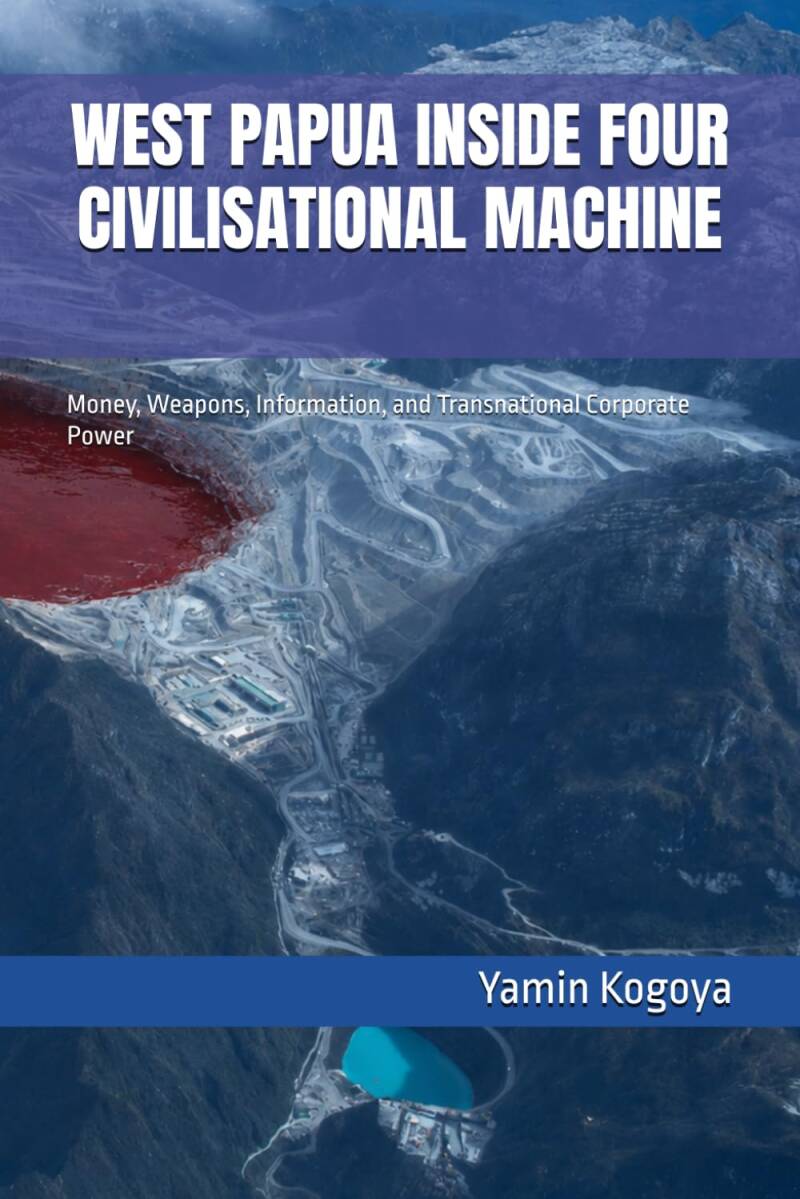
A mountain does not choose to become an asset. Something has to happen to it first.
In 1936, a Dutch geologist named a bare, ore-streaked peak in the New Guinean highlands "Ertsberg" — meaning "ore mountain" in Dutch. Twenty-three years later, an American company confirmed that it contained one of the largest copper deposits on Earth. What followed was not one story, but four: a financial system that determined who would benefit from it; a military apparatus that ensured extraction could proceed regardless of consent; an information system that controlled how the world understood what was happening; and a corporate network that distributed the resulting wealth to a world that never saw the mountain.
This book names that four-part system and traces it across ninety years of documented history.
Building on established research from the IMF, UNCTAD, SIPRI, the OECD and the UN's own human rights architecture, and extending Dwight Eisenhower's term 'the military–industrial complex' into a new geography, the book identifies the financial–industrial, military–industrial, technological–information and transnational–corporate complexes as one interlocking architecture of power rather than four separate 'issues' to be assessed in isolation. The book traces this architecture from the first agricultural surplus at Uruk, through the collapse of the gold standard at Bretton Woods, to the specific contracts, arms transfers and corporate networks operating in West Papua today. It asks why more than sixty years of documented Papuan appeals to the world's institutions have not changed the structure producing those appeals.
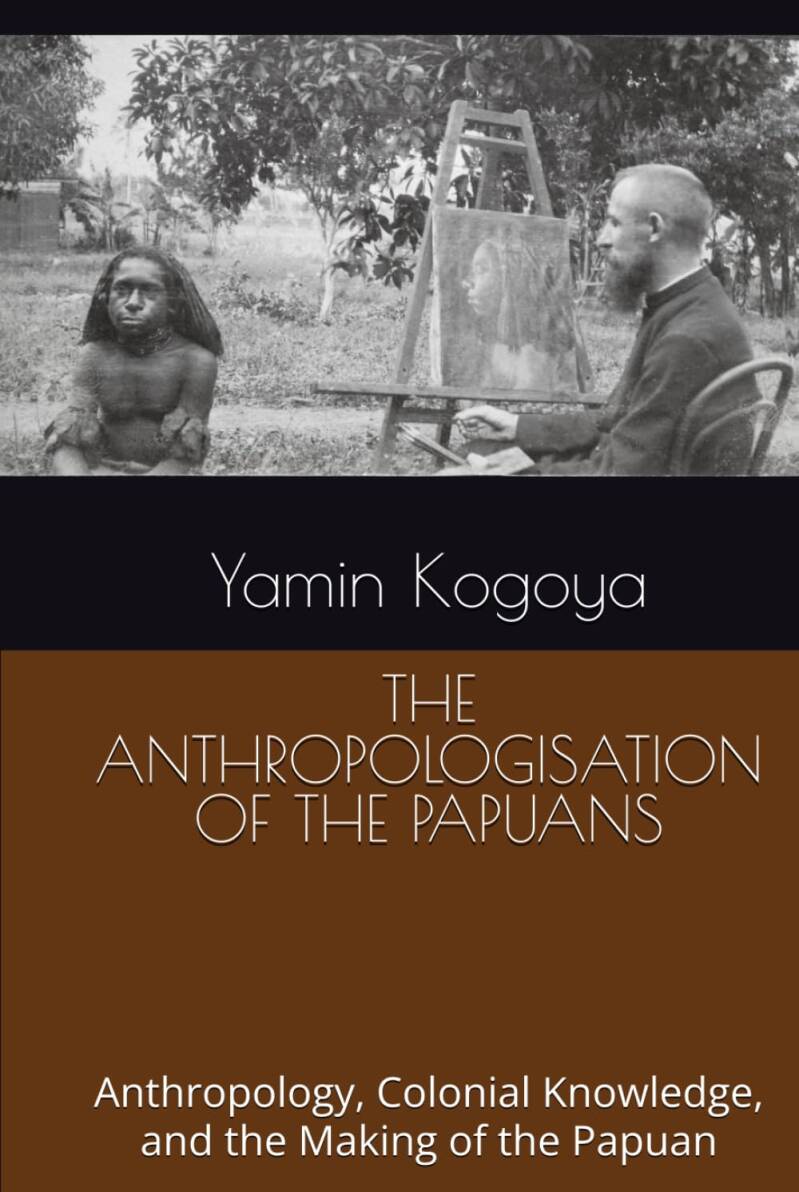
THE ANTHROPOLOGISATION OF THE PAPUANS: Anthropology, Colonial Knowledge, and the Making of the Papuan
There is no such thing as a Papuan. There is only the Papuan that five centuries of foreign description has manufactured — and mistaken for a discovery.
This is a book about a crime scene where no one thinks a crime occurred: explorers who 'found' a people. Explorers who 'found' a people. Missionaries who 'saved' a people. Colonial administrators who 'classified' a people. Anthropologists who 'studied' a people. And now, human rights reporters and solidarity movements who 'give a voice' to the Papuans — each certain that they are finally getting it right — are in fact extending the same five-hundred-year operation: the conversion of a living cosmology into an object of someone else's expertise.
The anthropologisation of the Papuans names and dismantles that operation. Across six parts and forty-nine chapters, it presents an original theoretical apparatus for tracking how knowledge production itself became colonialism's most enduring weapon — more enduring than the plantation or the mission station — because it never needed to justify itself as violence. The book examines exploration narratives, missionary ethnographies, colonial administrations, developmental anthropologies and contemporary NGO and journalism complexes as a single, continuous mechanism rather than as separate eras with different ethics.
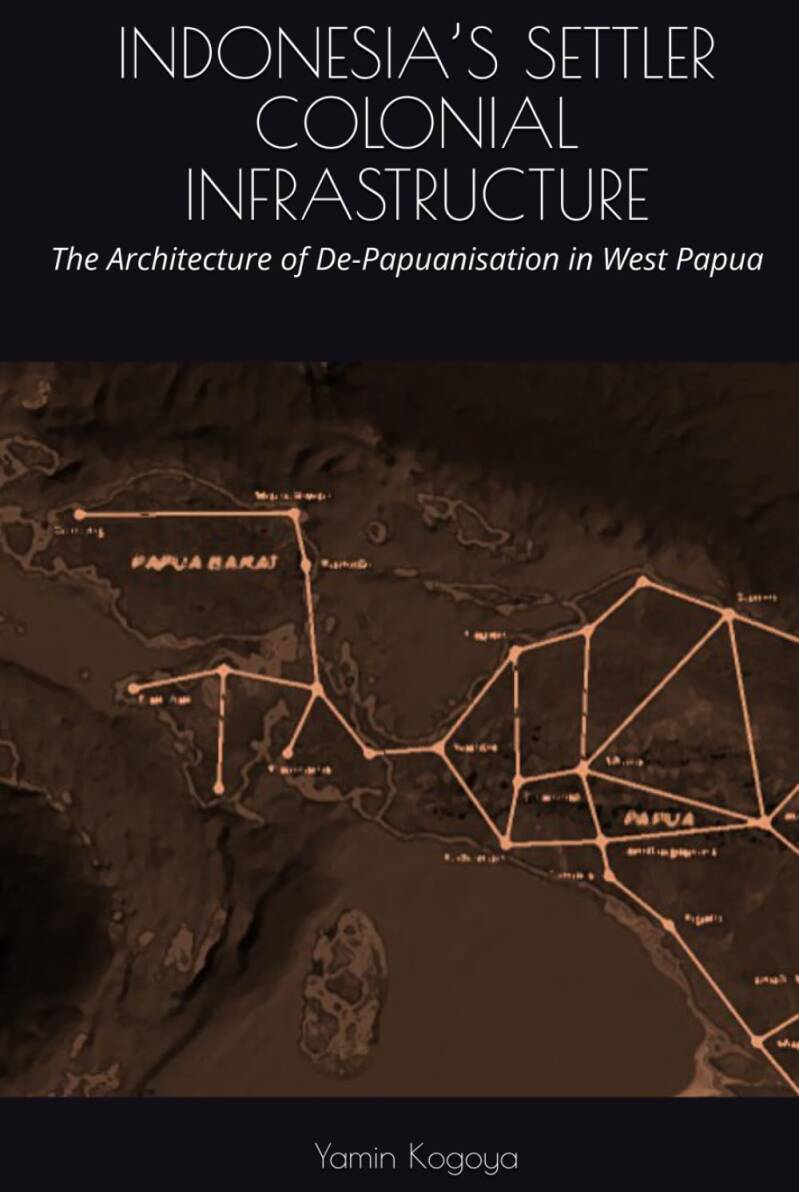
INDONESIA’S SETTLER COLONIAL INFRASTRUCTURE: The Architecture of De-Papuanisation in West Papua. Each name given to this land has been a claim over it.
From Nederland's Nieuw-Guinea and West Irian to Irian Barat, Irian Jaya and Papua, each name has signified ownership and purpose. In Indonesia's Settler-Colonial Infrastructure, Yamin Kogoya argues that the Indonesian state's policies in West Papua — including its names, roads, schools, churches, laws, maps, markets and ministries — are not separate entities. They are all parts of one system, and they all serve one purpose: De-Papuanisation: the slow and systematic extinction of the Papuan world.
Within the Psycho-Cosmocide framework, Kogoya dissects this machine organ by organ. He identifies ten interconnected systems: physical, security, governance, settlement, finance, biology and demography, culture, metaphysics, epistemology and space-time. He traces these systems across five layers, from the material to the ontological, down to the ultimate ontological system beneath them all: the unseen order that decides what counts as real, valuable, and human. The machine does more than take land. It enters the Papuan mind and teaches its hosts to participate in their own disappearance.